Total Pageviews

Friday, 22 November 2013

Luboks and Leaves

As part of my research into the best way of producing some Fleamsy books for your delectation and delight, I have been looking again at luboks.  Unlike Western European woodcuts on broadsides and pamphlets, luboks were in colour.

I have tried some linocuts in colour, and am next going to see about linocuts which fake a lubok style.  Here are some examples of my work with colour:

Plain Brown

Green and Brown

Green and Dark Green

Green and Teal
I think there are definite potentials there.  Or capabilities as my hero Capability Brown would have said.  That reminds me, this weekend we are going to Kirkharle to see the Capability Brown visitor centre there.  I'll take some photos for you.  Toodles!

Thursday, 21 November 2013

Badgers, Books and The Curse of Amen-Ra

Some more notes about Norwich: taxidermy seems very popular.  Miss Aimson had spotted a bookshop with a stuffed badger in the window, and a teashop with a stuffed fox, and we saw a stuffed razorbill in one antique shop.  There seemed quite a taxidermy-vibe in the town as a whole. 

The bookshop with the badger is called The Book Hive.  It is a fantastic old building.  There are tiny stairs to the top floor, where a couple of papier mache hives hang:

Hold You Hard!

A Book Hive
What a perfect bookshop!  We also wandered round The Book Man, which Miss Aimson directed us to, it already being a favourite of hers.  I was thrilled to find these pulp fiction horror and startling mystery magazines:

Horror!

Startling Mystery!

More Horror!

Even More Horror!
I am totally in love with them and I haven't even read them yet!  Another perfect bookshop and we still have Tombland Books to try another time.  Hold you hard!  More books than you can shake a stick at!

Wednesday, 20 November 2013

Giants, Tombs and Whistlefish

So where have I been?  We went to Norwich to see Miss Aimson at the weekend, then I have been stuck in the house with a cold.

Norwich - what can I say?  First impressions are that it is the Canada of England: really, really nice, polite, unhurried, the kind of place where bad things don't happen very often.  Loads of old stuff, loads of bookshops, the kind of things Aimsons like.  And a HMV.  You don't see many of them about these days.

There seemed to be some sort of Bolsover connection which I haven't looked up yet.  But they like big things in Norwich too:

A Bolsover-style Big Portico


Some Bolsover-style Giants


A Giantess
Oh no, that last one isn't a giantess; it's Miss Aimson standing in a tiny doorway.

Norwich's speciality seems to be great street names.  Try Whistlefish Road or Upper Goat Lane (and of course, Lower Goat Lane)


And, as I have asked on other occasions: Where are all the Goths?  Norwich has an area of town called Tombland:

Where are all the Goths?

Gothland

In Tombland we spotted Tombland Alley, Tombland Antiques and Tombland Books.  Miss Aimson hasn't been in that one yet, but surely she needs to work there?  Tombland Books would be perfect on her CV.

Tombland is the area immediately around the Cathedral.  We went in for a look round.  It isn't too good for art history as it was well and truly cleansed by the Puritans, so there isn't much to see.  I did spot a coat of arms which included the three crescent moons of the Ogles.  There is the possibility then of a real connection to Bolsover Castle, not just in their mutual love of Big Stuff.  Although I must say Bolsover still has them beat on the Big Stuff front.  Obviously Norwich is too modest and gentle to go for really big stuff, and certainly not for balls and boobs.  Far too polite for any of that sort of thing.  More the gentle humour of silly place-names.  I think I agree with them for long-term amusement.

Friday, 15 November 2013

A Fleamsy Manifesto and Funny Cats

The Fleams Manifesto has been succinctly summarised (by Liz) as : If someone is being a bit grumpy, or just generally a nob, they should be required to watch funny cat videos.  That is the theory of Fleams summed up in a sentence, but there is a vast background argument supporting this.

I am just finishing Vol. 2 of The Lord of The Rings, and will then be slowly carrying on with Vol. 3.  I am enjoying reading them, but, knowing of them beforehand, I am also comparing what they are to what I thought they were.  I have found myself surprised at the pleasure I have had from parts of them, especially Tom Bombadil and Goldberry, Elrond, and Treebeard.  I love those mystical passages of the story.  It has made me realise why the books were so popular and influential.

After a trying couple of weeks here at Aimo's House, I have decided to stop hankering after The Land of Cockayne, with its promise of effortless ease, and concentrate a bit harder on real life.  Tolkien presents a true picture of real life; it  is a mixture of struggle, endurance, fate and unexpected pleasures.  To be searching for Cockayne is to be constantly dissatisfied.  As The Buddha says "Life's shite, get over it".  Paganism, as I define it, says "Life's shit sometimes.  Life's great sometimes.  Life rocks, because the alternative is non-existence".

Thanks Tolkien for reminding me of this truth.  That is why making art, fiction, escapism and eye-candy are valid jobs.  They strip away the lies The Man tries to confuse us with, and make us remember what is real life.  So, onward pagan soldiers!  Fight when you need to fight, endure when you can't fight, and have some fun when you can.  Life's too short not to watch funny cat videos.

Wednesday, 13 November 2013

Bibliographies, Eye-candy and String

I love bibliographies.  When I get a new non-fiction book I always look at the back pages for the bibliography.  More books!  The only thing I like better than a bibliography is a glossary of obscure words.  I bought this book in Chesterfield the other week:

Great Bibliography!
I haven't read much of it yet, just some of the appendices and the bibliography.  I spotted this title as pretty cool:

Leechdoms, Wortcunning and Starcraft of Early England. Three vols. 1864-6

How cool is that for a title?  Then I spotted the author:

The Rev O Cockayne!  Further clues on the trail of Cockayne!  One day I will get to Easy Street, Cockayne and there will be no more banks hassling me, no sister-in-laws making trouble, no redundancy threats, no malfunctioning boilers.  It's gonna be great.

In the meantime, titles with the words wortcunning, leechdoms and starcraft will have to do.  I know what wortcunning is, and what leechcraft is, but what do the others involve?  Pondering such things helps keep the world of boring reality at bay for a while.  Escapism is a dirty word in literature and art.  I don't know why.  It's a bit like the sneering term eye-candy in art.  Like it is offensive for art to be pleasurable to the eye.  Personally I give my eyes all the candy they want.  I don't know how else to approach being an artist.

But back to the bibliography.  Some more cool titles I spotted:

Cats' Cradles From Many Lands, Kathleen Haddon, London 1911

String Figures, C F Jayne, New York, 1906.

Whole books about Cats' Cradles and String Figures!  Life may be too short for fiction, but surely not too short for those!

It reminds me of a note I have seen from Kate W Aimson to her publisher:  "Is a readership of witches with a keen interest in needlework scholarship and wordplay to narrow a market to aim for?"

We'll see.

Tuesday, 12 November 2013

Alphabets and Fleams

I wrote a rhyme for an alphabet of Fleams.  This is how it goes:

A is  A cat with a fiddle (haven't they all?)
B is  Button Sarah, leaning on a wall
C is  Canholes Asylum, for the permanently off-beam
D is  Dickey, the skull who likes to scream
E is  Eagle and Child, a strange way to be found
F is  Fenny flying to Fairholme, under the mound
G is  Gracie Sweetheart, and her rescue-supplying rocket
H is  Haunting hare, with a key in her pocket
I is  Drum's Iron, spouting a tail of flames
J is  Jawbone band, known by many names
K is  Kibble, full of lead
L is  Long Meg, never really dead
M is Mermaid, sewing under the pool
N is  Needleworkers and their rule
O is  Oracle stones, made to divine
P is  Pie-Tree, they serve beer and wine
Q is  Quill, and ink made of gall
R is  Rush-bearing to freshen the hall
S is  Spinning Jenny spinning in the wood
T is  Toady Old Man with his safety hood
U is  Uncle Erik, a very wicked man
V is  Violets, Parma, I'm certainly a fan
W is  Winking Man, driven by pistons and steam
Y is  Yarb doctoring, don't leave it too late
Z is  ZZ dreamz of Fleamz, spied through the gate

This rhyme was written to be illustrated with my woodcut-style linocuts.  However, I have over-reached my current capabilities in this skill.  Although I can picture the required illustrations in my mind, I am not sufficiently capable at the moment to reproduce them to show them to you. 

I have been wrestling with the problem until it all became clear this morning.  Fuck Robert the Bruce and his spider, if at first you don't succeed, give up and move on, I say.  In Fleams they say "If it's too hard, it ain't worth a fuck".  No, hang on a minute, I may be misleading you.  I think, in fact, in Fleams they say  "If it ain't hard, it ain't worth a fuck".  But that's another story.

Monday, 11 November 2013

Vampires, Kilts and Arguments

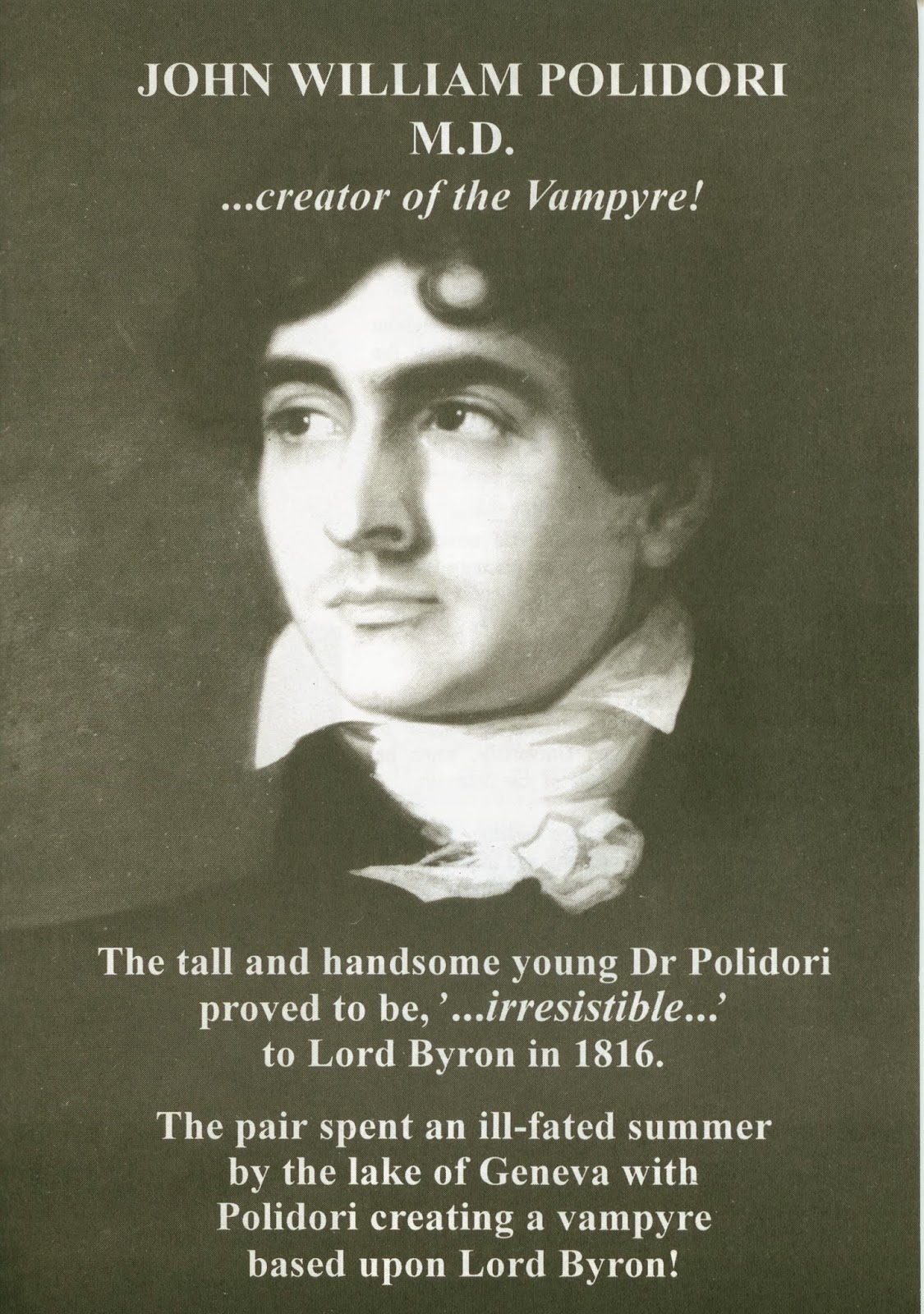
This weekend I have been thinking about Vampires.  I was reading about the emergence of the vampire as a character in English literature, and the surprise was that early English readers would have expected a vampire to be Scottish.  This because The Vampyre - A Tale written by John Polidori in 1816 featured Lord Ruthven as the villain (anti-hero?) of the story.

A Booklet from Newstead Abbey
Although the aristocratic Lord Ruthven is usually assumed to be a thinly disguised Lord Byron, readers would associate the name with Jacobite troubles in Scotland.  I did intend to show you a picture of Ruthven barracks in Scotland, a huge imposition of English military might in an invaded land, but I couldn't find the photo, so here is a piper instead:

A Piper on the Border

So English readers in 1817 would expect a vampire to be illustrated in a kilt.

This made be think about kilts and tartans in general.  A little tip of mine is if you want to start a fight with a Scotsman try saying clan tartans were invented by the English.  That will usually do it and get you into a good old argument.  Before you start though, get your argument straight by reading this book first:


A Good Book for an Argument

It should equip you with all the facts you need.  Happy punch-ups!